Machining Center Buying Guide: Vertical vs Horizontal and Key Specs
How to choose a CNC machining center: vertical vs horizontal, table and travel, spindle taper, speed and drive, controller and rigidity for production milling.
Vertical vs Horizontal Machining Center
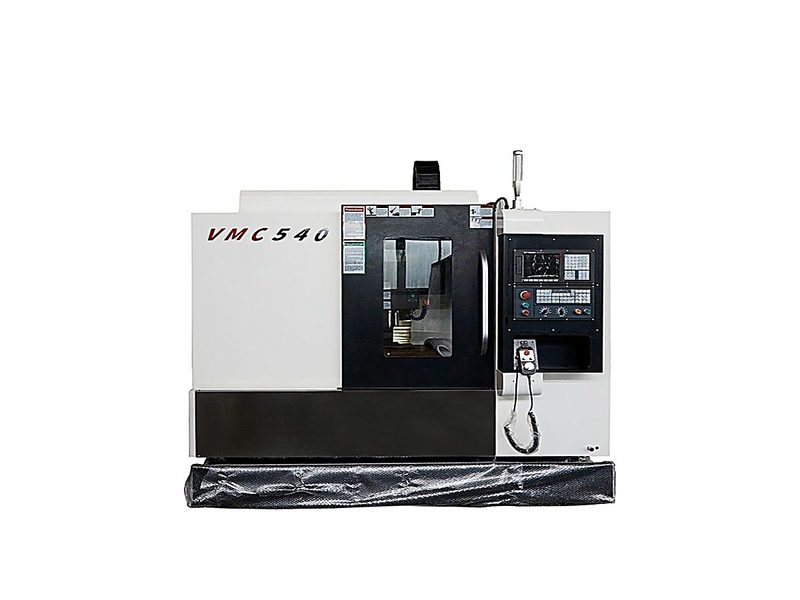
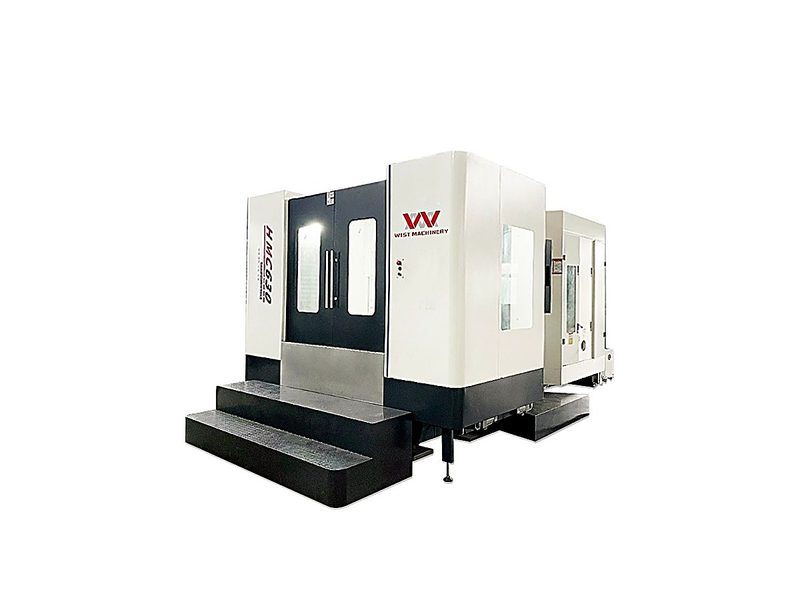
A vertical machining center (VMC) mounts the spindle in the vertical direction and suits face milling, drilling, tapping and general mold or plate work, making it the most common choice for general workshops. A horizontal machining center (HMC) holds the workpiece on a rotating pallet with the spindle horizontal, which sheds chips better and serves production of box-type and multi-sided parts. Choose a VMC for plates, brackets and molds; choose an HMC for repeated multi-side production on larger workpieces.
Table Size and Axis Travel
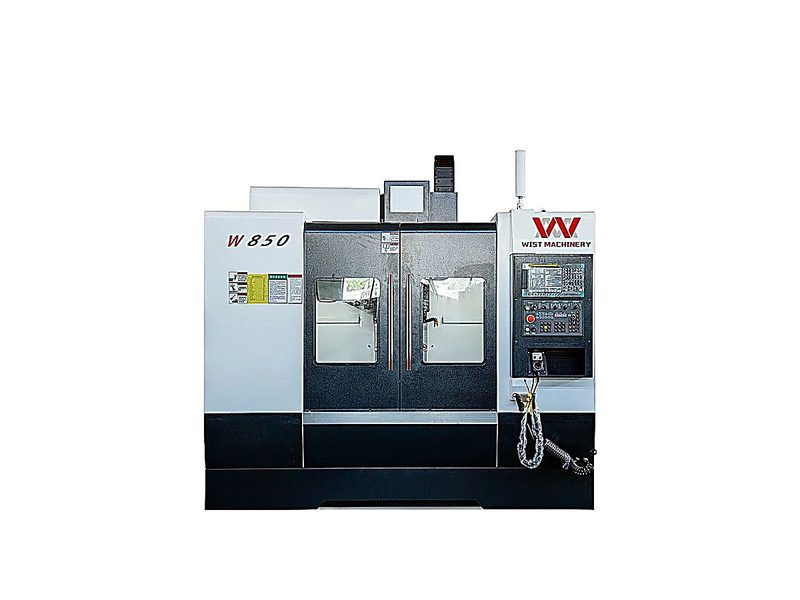
Match the table and X/Y/Z travel to your largest fixture and part length. The compact W540 takes a 600x400 mm table with 480/360/400 mm travel for small and medium parts; the W650 steps up to an 800x500 mm table and 600/500/500 mm travel; the W850 carries a 1000x500 mm table and 800/500/500 mm travel; the W1160 reaches a 1200x600 mm table and 1100/600/600 mm travel. The heavy W1580 uses a 1600x800 mm table with 1500/800/800 mm travel for long, heavy parts.
Spindle Taper, Speed and Drive Power
Spindle taper and speed set the tooling and cutting range. BT40 spindles at 8000 r/min (W540, W650, W850, W1160) suit high-speed general milling; BT50 and No.50 tapers with stronger 15/18.5 kW drives (W1580, W630) handle heavier cuts and larger tools. Check the main motor power against your material, depth of cut and whether you mainly rough or finish.
Rigidity, Casting and Guideways
Rigidity holds tolerance and surface finish under cut. WIST vertical centers use high-rigidity cast-iron or resin-bonded sand castings with aging treatment, precision linear guideways and imported ball screws, guideways and couplings to keep vibration low and positioning stable. The W1160 is built for both roughing and finishing; heavy models rely on a strengthened column and wide base.
Controller and Optional Automation
The W1580 runs KND2100 or GSK25I control as standard, with FANUC, SIEMENS or MITSUBISHI optional. Confirm the controller language, cycle compatibility and available tool magazine, pallet or fourth-axis options for your production before ordering.
Match the Machine to Your Workload
List your largest workpiece, material, tolerance, batch size and budget, and compare table, travel, spindle and drive against these numbers. Send us your part drawings and expected quantity, and we will recommend a vertical or horizontal machining center with a FOB quote within 24 hours.
FAQ
The W1580 carries a 1600x800 mm table rated to 1000 kg, with 1500/800/800 mm X/Y/Z travel and 150-850 mm from spindle nose to table. That is long-plate and heavy-fixture territory: add the fixture height, the tool length and the part to check you still reach the lowest feature, and keep the part inside the 7-22-110 mm T-slot pattern when you design the fixture.
BT40 at 8000 r/min, as on the W540, W650, W850 and W1160, suits high-speed general milling of aluminium, small steel parts and mould work with lighter tools. BT50 at 6000 r/min on the W1580 and W630 pairs a 15/18.5 kW drive with heavier tooling for deep cuts, large face mills and long-reach operations. Specify the taper your tooling inventory and cutting strategy already assume.
Look at the depth of cut and the material removal rate you actually plan, not the maximum the spindle can deliver. A 15/18.5 kW BT50 spindle on the W1580 handles serious roughing passes in steel and cast iron; BT40 machines with lower power are efficient for lighter cuts at higher speed. Undersizing power shows up as chatter and burnt tools; oversizing it shows up as a machine that never runs near its capability.
Size the electrical supply on total connected load, not just the spindle: on the W1580 the spindle alone is 15/18.5 kW and the three axis motors add 3.0/3.0/4.5 kW, before the coolant pump, chip conveyor and cabinet are counted. Ask for the foundation and layout drawing before the machine ships, and allow clearance for the table at full travel plus a pallet or crane route for loading heavy workpieces.
KND2100 and GSK25I are the standard fit on the W1580, with FANUC, SIEMENS or MITSUBISHI quoted as options. Choose on operator familiarity and spare-parts reach: GSK and KND are well supported across Asia, Eastern Europe and many distributor networks, while Fanuc or Siemens makes sense when your maintenance team, CAM posts and customer base already run them. Confirm the control language and the CAM post-processor before shipment.
Not sure which machine fits your job?
Send us your workpiece details and target budget — our export team will reply within 24 hours.