CNC Turning Machines: Types, Benefits and How to Choose
Complete guide to CNC turning machines: types (horizontal, slant bed, 4-spindle), key benefits, how to select by part size, batch size and tolerance, plus pricing hints.
What Is a CNC Turning Machine?
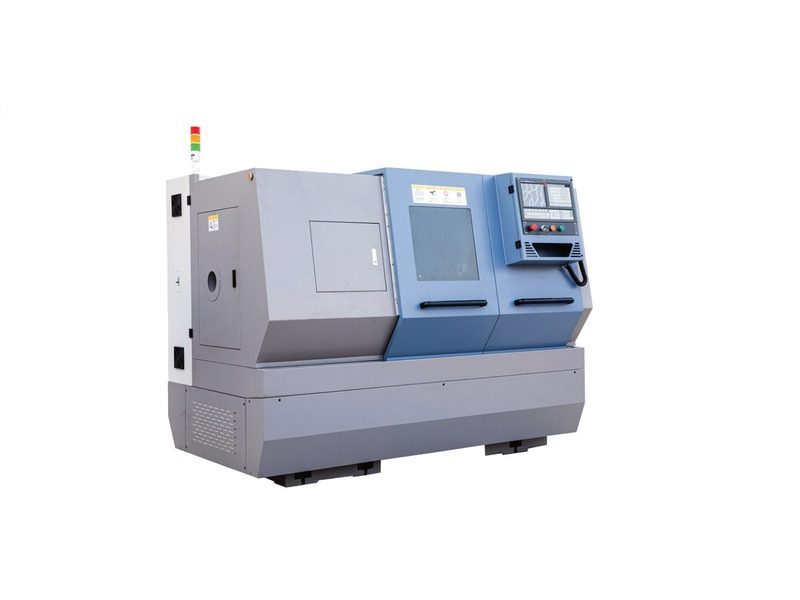
A CNC turning machine — commonly called a CNC lathe — rotates a workpiece against a single-point cutting tool mounted on a computer-controlled turret. The controller reads a G-code program and moves the tool along X and Z axes to produce cylindrical, conical, threaded and contoured parts. Modern CNC turning machines can be equipped with driven tools, live tooling, Y-axis and sub-spindles, allowing milling, drilling and cross-axis operations in one setup — effectively a turn-mill center.
Compared with manual lathes, CNC turning machines deliver consistent repeatability, shorter cycle times and lower labor cost per piece. They are the backbone of automotive, hydraulic, pneumatic, medical and fastener production worldwide.
Main Types of CNC Turning Machines
Flat-Bed Horizontal CNC Lathe
The classic layout: a horizontal bed with a flat guideway, manual or hydraulic chuck, tailstock and 4/6/8-station electric turret. Best for long shafts, pipe threading, flanges and general shop turning. The CK6432 and CK6166 from WIST fall into this category.
Slant-Bed CNC Lathe
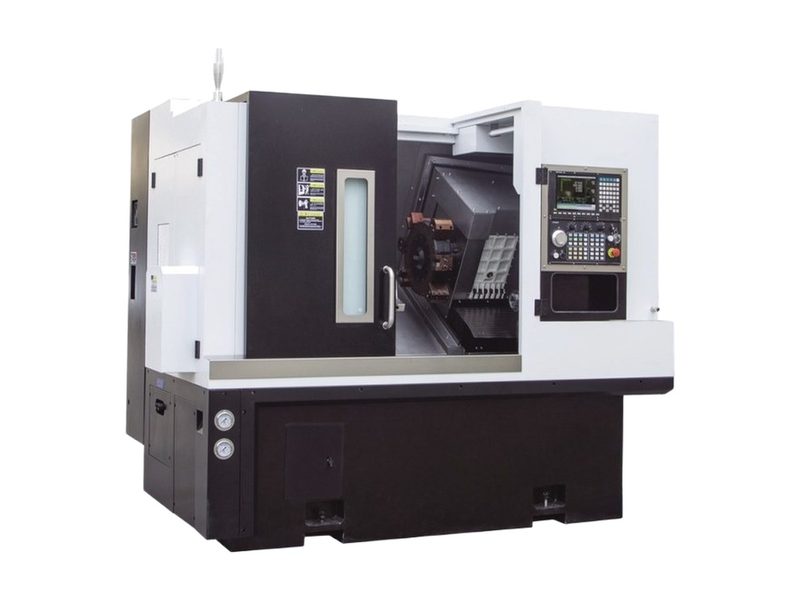
The bed is angled at 30–45 degrees so chips fall away by gravity. Better rigidity, easier operator access and shorter chip-to-chip time. The TK4036 slant bed CNC lathe is a typical compact slant-bed machine for precision parts.
Turn-Mill Center (with Driven Tools)
A turret with live tools can drill, tap, mill and polygon-cut without moving the part to a separate mill. Ideal for complex parts that would otherwise need two setups.
Multi-Spindle / Four-Spindle Turning Machines
Four-spindle and multi-spindle automatics run four or more bars simultaneously, producing up to four parts per cycle. They dominate high-volume simple parts — bolts, sleeves, ferrules, hose fittings — where cycle time in seconds matters. WIST supplies both single-spindle CNC lathes and multi-spindle configurations for buyers in automotive and fastener supply chains.
Key Benefits of CNC Turning Machines
- Repeatability: once the program and offsets are proven, every piece is identical — critical for OEM supply.
- Lower labor cost: one operator can run 3–6 machines, compared with one manual lathe per operator.
- Complex geometries in one setup: threads, tapers, radii, eccentric bores, polygon milling — all from one program.
- Reduced scrap: proven offsets and first-article checking cut scrap rates versus hand-fed manual work.
- Data capture: modern controllers log cycle times, tool life and alarm history for production management.
How to Choose the Right CNC Turning Machine
1. Part Size and Chuck Capacity
Measure the largest bar diameter, maximum turning length and required bore. Match the swing over bed, maximum cutting diameter and chuck size (6", 8", 10" or 12"). For long shafts, pay attention to the maximum turning length and tailstock travel.
2. Batch Size and Cycle Time
Small batches (under 100 pieces) can use an economical flat-bed CNC. High-volume simple parts justify a multi-spindle or bar-fed CNC. Very complex parts need driven tools and Y-axis.
3. Tolerance and Surface Finish
For IT6 or tighter tolerances and Ra 1.6 or better, look for hardened and ground box ways, linear scales, chilled spindle structure and thermal compensation. Slant-bed machines typically outperform flat-bed on finish.
4. Control System
FANUC, Siemens, Mitsubishi and GSK are the mainstream options. Choose a control your maintenance team already knows — spare parts, training and resale value all depend on it.
5. Automation Readiness
If you plan a lights-out shift, spec a bar feeder, automatic parts catcher, chip conveyor and hydraulic chuck up front — retrofitting later is more expensive.
CNC Turning Machine Price Ranges (2026)
Entry-level compact CNC lathes (300–500 mm swing) from Chinese exporters typically range from USD 8,000 to 25,000. Mid-size flat-bed CNC lathes (CK6136, CK6140, CK6150) range USD 18,000–45,000. Slant-bed turn-mill centers with live tools start around USD 35,000 and scale up with axes and automation. Heavy-duty CNC lathes for 1,000 mm+ swing can exceed USD 80,000. Final pricing depends on chuck, turret, tailstock, material, controller and packaging — send us your specs for a firm quote.
Common Applications
- Automotive: shafts, bushings, flanges, connector bodies
- Hydraulics & pneumatics: piston rods, valve bodies, glands
- Fasteners & fittings: bolts, nuts, ferrules, hose connectors
- Agriculture: pivot pins, sprockets, gear blanks
- General engineering: repair parts, prototypes, low-volume production
What to Ask Your Supplier
Before ordering a CNC turning machine, ask for: (1) the exact swing, maximum turning length and spindle bore; (2) the chuck size and whether hydraulic chuck is included; (3) the turret station count and whether live tools are supported; (4) the controller model and whether it supports conversational programming; (5) CE/ISO documentation and English operation manual; (6) delivery time, payment terms and after-sales remote support. WIST Machinery exports CNC lathes to 60+ countries and provides all of the above with every order.
Send your part drawings, batch sizes and target cycle time to WIST Machinery via the contact page or WhatsApp +86-18852573536. Our export team will recommend the right CNC turning machine configuration with a factory quote within 24 hours.
Need a CNC turning machine quote?
Send us your part drawings and batch sizes — our export team will reply within 24 hours.